
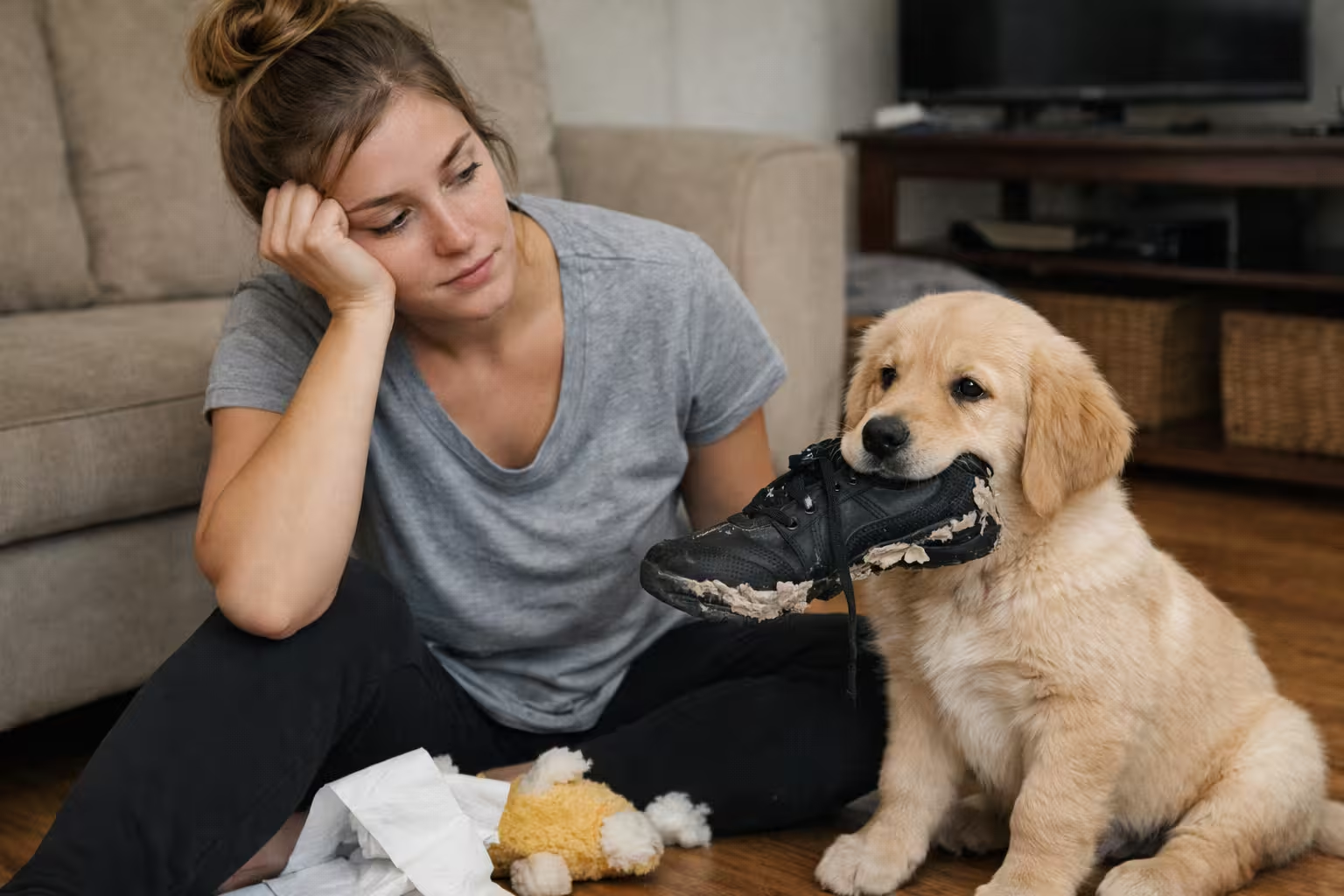
Your puppy ricochets off the walls at 6 a.m., destroys your favorite shoes by noon, and gets the zoomies at bedtime.
You’re exhausted. The useful answer is that puppy energy usually changes gradually. There is no honest calendar date when every dog flips from chaos to calm.
Maturity helps. So do sleep, routine, training, health, and realistic outlets for the dog you brought home. A Border Collie and a Bulldog should not be expected to live the same day, and two puppies of the same breed can still act very differently.
Short answer: Look for progress through adolescence and young adulthood instead of waiting for one birthday. Your puppy is calming down when they recover from excitement faster, choose to rest without constant help, and respond to familiar cues around ordinary distractions.
What “calm” actually looks like
Calm does not mean sleepy all day. It means your puppy can move between activity and rest without staying stuck in overdrive.
Useful signs include:
- Settling after play instead of launching straight into biting or barking
- Choosing a bed, crate, or quiet floor space without being sent there every time
- Pausing long enough to respond to a familiar cue
- Recovering from a visitor, walk, or exciting sound more quickly
- Waiting briefly for food, doors, or play
- Sleeping regularly instead of fighting every nap
These changes often arrive unevenly. You may get a calm week followed by three loud days. That does not erase the progress.
Why one puppy settles sooner than another
Breed history changes the daily workload
Dogs were bred for different jobs. Herding dogs notice movement. Retrievers carry things. Northern breeds travel and work. Terriers chase, dig, and persist.
Those traits do not create an exact maturation schedule. They do change what a workable day looks like.
The AKC describes terriers as energetic dogs with the persistence needed for vermin work. The AKC describes Samoyeds as social dogs that need daily exercise and involvement with their people. Waiting for either dog to become a couch potato is likely to frustrate everyone.
Your job is to give the breed’s normal traits a safe outlet, then teach the dog how to stop.
Development is not a straight line
Adolescent dogs often become more interested in the environment and less consistent around distractions. Skills that looked finished may wobble.
AAHA’s canine life-stage guidance says developmental periods phase in and out gradually, and that behavior reflects age, experience, breed, and environment. That is why a calendar can give you context but cannot predict one puppy’s behavior.
Treat that as a reason to lower the difficulty and practice again. It is not proof that your puppy is defiant or that the training failed.
Sleep and arousal can look like excess energy
An overtired puppy often looks wired. Mouthing gets harder. Zoomies get faster. Familiar cues seem to disappear.
Before adding another long walk, check the basics:
- Does the puppy need to toilet?
- Have they eaten and had water?
- Have they had a reasonable chance to sleep?
- Was the last activity exciting enough that they need a quiet transition?
- Is the room making rest difficult?
More activity is not always the answer. Sometimes the missing piece is a dimmer room, a safe chew, and fewer people stirring the puppy back up.
Pain, illness, and fear need a different response
A sudden behavior change deserves attention. Call your veterinarian if new restlessness comes with pain, appetite changes, vomiting or diarrhea, trouble breathing, repeated pacing, inability to get comfortable, or unusual distress.
Fear also needs space and a careful plan. Do not force a frightened puppy toward the thing they fear. The American Veterinary Society of Animal Behavior recommends reward-based methods for training and behavior work. For persistent fear, anxiety, or aggression, involve your veterinarian and a qualified reward-based behavior professional.
Breed traits and calmer behavior
No breed has a defensible age when calm is guaranteed. Breed history can still help you build a routine that fits the dog in front of you.
When do Bulldogs calm down?
Bulldogs are often less driven to sustained activity than many working breeds, but a Bulldog puppy still needs training, play, and practice settling. The AKC Bulldog profile recommends moderate exercise and warns that the breed’s short muzzle makes heat and humidity risky.
Do not mistake breathing difficulty or heat intolerance for maturity. Use short, comfortable activity, avoid hot conditions, and ask your veterinarian about noisy breathing or poor exercise tolerance.
When do Boston Terriers calm down?
Boston Terriers are companion dogs, but the AKC breed standard describes them as lively and highly intelligent. Small size does not remove the need for play, learning, and sleep.
Build the day around short walks, brief training, safe play, and planned quiet time. If your Boston gets frantic, shorten the exciting part and make the transition to rest easier. Do not chase a precise birthday.
When do terriers calm down?
Many terriers keep the alertness, persistence, and chase drive they were bred for. Maturity can improve recovery and impulse control without erasing those traits.
Give that energy a job: sniffing games, short training sessions, food puzzles, tug with clear start and stop cues, or an appropriate dog sport. Then reward the boring moments too. A terrier who learns that lying quietly pays has a better chance of offering it again.
When do Samoyeds calm down?
Samoyeds are social working dogs. The AKC’s Samoyed guidance calls them high energy and stresses regular exercise, mental stimulation, companionship, and early training.
A mature Samoyed may become easier to live with while still needing real daily activity and contact with the family. The goal is a dog who can settle after those needs are met, not a dog who stops wanting to do things.
A practical calm-down plan
1. Protect sleep
Puppies need many chances to sleep. Use a crate, pen, gated room, or quiet bed that is comfortable and free from constant interruption.
If your puppy keeps waking because the household walks past, move the rest area. If confinement causes panic rather than mild protest, get help with the confinement plan instead of waiting for exhaustion to win.
2. Reward the behavior you want
Calm behavior is easy to miss because it creates no emergency. Notice it anyway.
When your puppy lies down on their own, quietly place a treat between their paws. When they watch a distraction without lunging, reward that choice. When they settle after play, let rest continue.
The lesson is simple: quiet choices work.
3. Keep training short and reward-based
Long drills can turn a tired puppy into a frustrated one. Practice one small skill for a few minutes, stop while the puppy is still successful, and repeat later.
The AVSAB humane training statement recommends reward-based training and environmental management. Teach the behavior you want, arrange the room so the puppy can succeed, and avoid pain or fear as training tools.
4. Use activity that fits the dog
Walks, sniffing, training, play, chewing, and food puzzles do different jobs. Mix them instead of trying to exhaust your puppy with one activity.
Skip universal exercise formulas. Safe activity depends on the puppy’s health, build, environment, and the activity itself. Ask your veterinarian about limits for your individual puppy, especially if you are planning repetitive running, jumping, or a new sport.
5. End play before control disappears
Watch for faster movement, harder mouthing, ignored cues, frantic barking, or a puppy who cannot pause.
That is your cue to lower the temperature. Offer water, take a toilet break, switch to sniffing or chewing, and move toward rest. Waiting for a full meltdown makes the landing harder.
6. Make the day predictable
A routine does not need to run by the minute. It needs a repeatable rhythm:
- Toilet, food, and a short activity
- Rest
- Toilet, training, or play
- Rest again
- A calmer evening transition
Predictability helps the puppy learn that activity ends and another chance will come.
Spaying or neutering is not a calm-down shortcut
Spaying or neutering does not teach a dog to settle. The procedure may affect some sexually driven behaviors, but the effects vary and it does not replace sleep, training, routine, exercise, or enrichment.
Make that medical decision with your veterinarian based on the individual dog. Keep the behavior plan separate.
When to ask for help
Get professional help when your puppy:
- Cannot settle even after basic needs and sleep opportunities are covered
- Shows persistent fear, panic, guarding, or aggression
- Becomes suddenly restless or behaves very differently
- Cannot tolerate being left or confined without severe distress
- Has breathing trouble, pain, stomach symptoms, or another physical change
Start with your veterinarian. For behavior support, look for a professional who uses reward-based methods and can explain the plan without dominance or punishment.
Your puppy does not need to become a different dog. They need a routine that fits, practice making calmer choices, and enough time for those choices to become easier.