
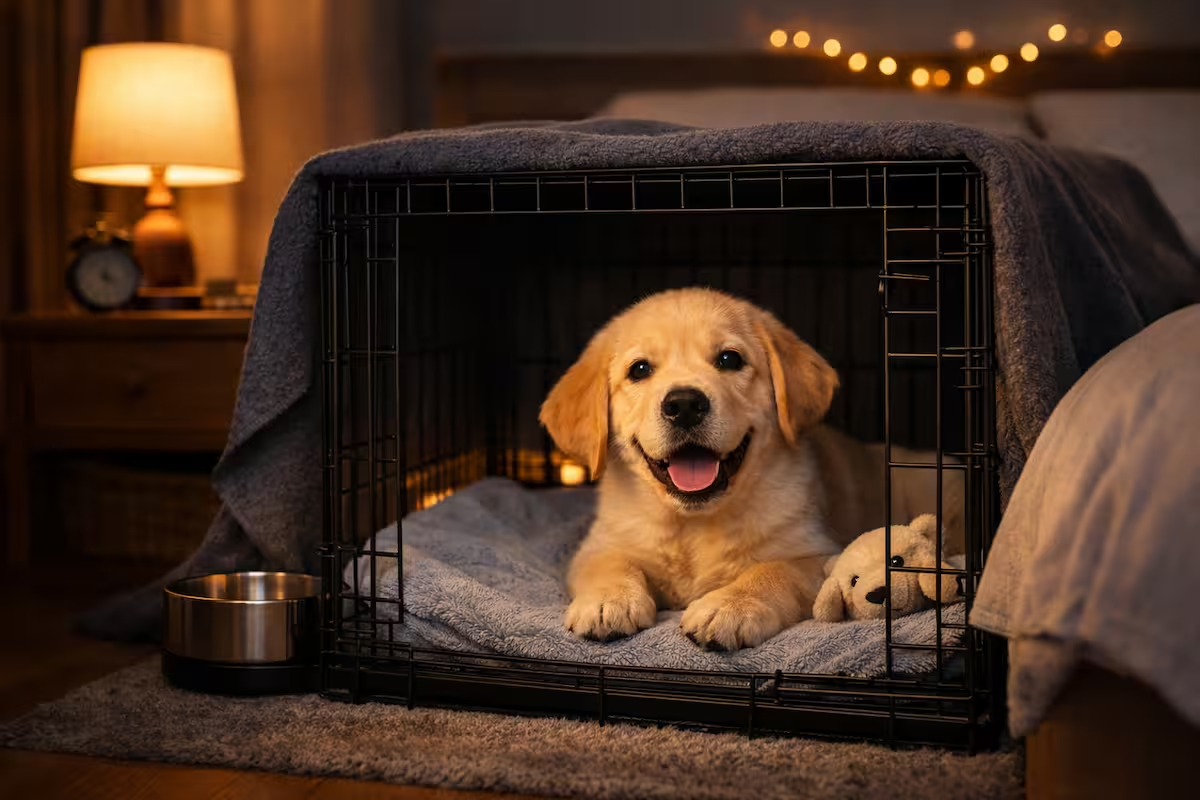
The first few days with a new puppy are usually a mix of excitement, sleep deprivation, and a lot of paper towels.
Your puppy doesn’t know where to sleep yet. They don’t know where the bathroom is. And they definitely don’t know which things in your home are toys and which things are… very much not toys.
This is where a safe management plan helps. A crate is one option. A pen, gated room, or puppy-proofed area may fit your puppy better.
When used properly, a crate becomes a safe place your puppy can relax, while also helping you:
- build a consistent routine
- speed up house training
- prevent destructive chewing
- keep your puppy safe when you can’t supervise
Crate training also makes travel, vet visits, and boarding much easier later in life.
If you haven’t chosen a crate yet, start with our guide to the best puppy crates for training, which explains sizing, dividers, and the most reliable crate types for puppies.
This guide combines recommendations from professional animal-welfare and behavior sources with practical crate-training steps.
Let’s start with the basics.
What Is Crate Training?
Crate training is the process of teaching a puppy to feel comfortable resting in a crate or kennel. Done correctly, the crate becomes a den-like space where a puppy feels secure, not trapped.
Dogs have a natural instinct to rest in enclosed spaces. This behavior goes back to their wild ancestors, who used dens for safety and protection.
As canine psychologist Stanley Coren explains in The Intelligence of Dogs, “Dogs are den animals and many naturally seek out small enclosed spaces where they can feel safe and secure.”
Animal behaviorist Temple Grandin often describes dogs as animals that feel calmer when they have predictable, structured environments. A crate provides exactly that—a consistent place where a puppy can settle and decompress.
When introduced gradually and positively, a crate simply becomes a modern version of that den.
In practical terms, crate training teaches your puppy three things:
- The crate is a safe place to rest
- Brief, comfortable sessions end before worry builds
- Routine matters
For overwhelmed new owners, that structure makes everything else—sleep, house training, and daily life—much easier.
Why Crate Training Is Important for Puppies
Crate training isn’t just about containment. It solves several common puppy challenges at once.
Maine Dog Training Company frames the crate as a management and structured-rest tool (opens in a new tab), not a punishment or a place owners should feel guilty about using. That perspective matters: a positively introduced crate can also prepare a dog for travel, boarding, grooming, and veterinary care.
That preparation can matter suddenly after an injury or surgery. Kathy Santo Dog Training’s crate-rest guide (opens in a new tab) offers low-movement enrichment ideas that can make veterinarian-prescribed recovery less frustrating for a dog who already knows how to settle in a crate.
Humane World for Animals describes crates as short-term training and management tools that should be introduced in small steps, never used as punishment, and not used as an all-day solution.
Here’s why most trainers recommend crate training.
1. It Helps With House Training
Puppies naturally avoid going to the bathroom where they sleep.
Because of this instinct, crates encourage puppies to hold their bladder until they’re taken outside, which accelerates potty training.
Animal behaviorist Patricia McConnell explains this clearly in The Puppy Primer: “The secret to housetraining is prevention — preventing mistakes while your puppy learns where they should go.”
A properly sized crate helps prevent accidents while your puppy learns the routine.
2. It Prevents Destructive Chewing
Puppies explore the world with their mouths.
Left unsupervised, that curiosity often turns into destructive chewing:
- furniture legs
- baseboards
- shoes
- power cords
A crate keeps your puppy safe when you can’t actively supervise them.
3. It Creates a Predictable Sleep Routine
Puppies need 18–20 hours of sleep per day, but most of them won’t settle on their own.
A crate helps teach puppies how to relax and sleep.
This is especially helpful during the first night with a new puppy, when everything is unfamiliar and overstimulating.
4. It Helps Reduce Anxiety
Structure is calming for dogs.
Stanley Coren, PhD, author of The Intelligence of Dogs, often notes that dogs thrive when they understand what’s expected of them.
Puppies thrive on routine. When their day follows a predictable pattern—sleep, play, eat, potty—they settle more easily.
Animal behavior expert Temple Grandin writes in Animals Make Us Human, “Animals are calmer when they know what is going to happen next.”
A crate helps create that predictability by giving your puppy a consistent place to rest.
When introduced correctly, many adult dogs voluntarily return to their crate because it feels like a safe resting place.
Choosing the Right Crate for Your Puppy
Before starting crate training, it’s important to pick the right crate.
The most important factor is size.
Your puppy should be able to:
- stand up comfortably
- turn around
- lie down fully stretched
But the crate should not be large enough for them to use one corner as a bathroom.
Most puppy owners solve this by using a wire crate with a divider panel, which allows the crate to grow with the puppy.
Spot Pet Insurance’s crate overview (opens in a new tab) compares wire, plastic, and soft-sided options and explains why both the material and the puppy’s expected adult size belong in the decision.
For a full breakdown of crate types and sizing, see our guide to the best puppy crates for training.
Other helpful crate features
Look for:
- good ventilation
- easy-clean tray
- secure latch
- divider panel for growing puppies
A crate and a puppy pen also solve different problems. Dog Academy’s pen-versus-crate comparison (opens in a new tab) is a useful decision guide: pens provide room for safe movement during longer awake periods, while crates are better suited to sleep, short management periods, housetraining, travel, and emergencies.
Once you have the crate ready, you can begin training.
How to Crate Train a Puppy (Step-by-Step)
The key to crate training is positive association.
You want your puppy to think:
“This place is comfortable and safe.”
Not:
“This is where I go when the fun stops.”
Follow these steps.
Step 1: Introduce the Crate Slowly
Start by placing the crate in a common area of your home.
Leave the door open and allow your puppy to explore it freely.
You can encourage curiosity by tossing treats or a toy inside.
Do not close the door yet.
The goal is simply to show your puppy that the crate is not something to fear.
📎 Related: See our complete guide to the Best Puppy Training Treats
Step 2: Make the Crate Comfortable
Add a few items that make the space inviting.
Good options include:
- soft bedding
- a safe chew toy
- a blanket with familiar scent
Avoid overcrowding the crate with toys. Too many objects can make it harder for your puppy to settle.
Step 3: Start With Short Sessions
Once your puppy enters the crate comfortably, you can begin closing the door briefly.
Start with only a few seconds while you remain nearby. Open the door before your puppy becomes worried.
Repeat at that easy level. Add duration only after several comfortable sessions.
Short, positive experiences build confidence.
Step 4: Feed Meals in the Crate
One of the easiest ways to build positive association is feeding meals inside the crate.
Place the food bowl in the crate and allow your puppy to eat with the door open at first.
Later, close the door during meals and reopen it once they finish.
Food is a powerful reinforcement.
Step 5: Gradually Extend Crate Time
Over the next several days, slowly increase crate duration.
Eventually you can begin leaving the room briefly while your puppy rests in the crate.
The ASPCA recommends gradually building crate time so dogs learn to relax rather than panic when confined.
Patience during this stage pays off later.
Let comfort and care needs set the schedule
A puppy’s bathroom needs, health, activity, and comfort all limit how long they can stay in a crate.
There is no reliable month-age-equals-hours formula. Two puppies of the same age can have very different limits, and a bladder estimate does not tell you whether a puppy is emotionally comfortable with confinement.
Plan frequent daytime breaks and expect young puppies to need overnight toilet trips. For every session, start below the point where your puppy shows worry. Use a pen, gated room, or puppy-proofed space when they need more room or when the crate itself causes distress.
Maggie Marshall’s four-step crate-training walkthrough (opens in a new tab) is especially helpful on two points new owners often misread: persistent distress means something in the setup needs attention, and nighttime crying should be handled as a quiet potty check rather than playtime.
Crate Training Games That Help Puppies Love Their Crate
One of the easiest ways to make crate training successful is to turn the crate into a place where good things happen.
Instead of only using the crate when you need your puppy to settle down, you can also use short games that build a positive association with the space.
Willow Creek Kennels demonstrates this approach (opens in a new tab) with food rewards and a clicker: teach the puppy to choose the kennel, mark the correct decision, and build comfort before asking for longer confinement.
These games are simple, quick, and surprisingly effective.
1. The Treat Toss Game
This is one of the easiest ways to encourage puppies to enter the crate willingly.
Stand near the crate and toss a small treat inside.
When your puppy walks in to get it, calmly praise them.
Then toss another treat just outside the crate so they come back out.
Repeat this a few times.
Your puppy quickly learns that going into the crate leads to rewards.
2. The Surprise Toy Game
Occasionally place a favorite toy or chew inside the crate when your puppy isn’t looking.
When they discover it later, the crate starts to feel like a place where good surprises happen.
You don’t need to do this every time — the occasional discovery keeps the crate interesting.
3. The Meal-in-the-Crate Game
Feeding meals inside the crate is one of the most powerful ways to build positive associations.
Start with the crate door open.
As your puppy becomes comfortable, begin closing the door during meals and opening it again once they finish.
Many puppies begin running into the crate on their own once they realize mealtime happens there.
4. Short “Relax and Release” Sessions
Once your puppy is comfortable entering the crate, practice short calm sessions.
Guide them into the crate with a treat, close the door for a few seconds, then open it while they are still comfortable.
This teaches an important lesson:
The crate door opens before the exercise becomes difficult.
Why These Games Work
Dogs repeat behaviors that lead to rewards.
When your puppy experiences treats, toys, meals, and calm praise around the crate, they begin to see it as a safe and positive space rather than confinement.
Over time, many puppies will walk into their crate on their own when they’re tired.
How to Handle a Puppy Crying in the Crate
This is one of the most common concerns for new puppy owners.
The short answer: mild fussing and escalating distress need different responses.
But normal adjustment is not a reason to ignore escalating distress. The Ontario SPCA cautions that simply letting a dog cry it out (opens in a new tab) can build stress and a negative association with confinement. If the dog is struggling, return to the last successful step, shorten the session, and consider a different dog-proof setup when a crate is not the right tool.
Your puppy has just left their littermates and is adjusting to a completely new environment.
Instead:
- Check whether the puppy needs to toilet or is too hot, cold, or uncomfortable
- Stay close enough to offer quiet reassurance during the first nights
- If distress is building, end the session calmly and make the next practice easier
If the crying continues for long periods, it may indicate that the puppy:
- needs a bathroom break
- is overstimulated
- has spent too long in the crate
Do not wait out panic to get a silent moment. The PDSA crate-training guide recommends going back a step if a dog shows signs of worry and moving at the dog’s pace.
📎 Related: How to solve Puppy Crying at Night
Crate Training the First Night
The first night is often the hardest part of crate training.
Most puppies have never slept alone before.
A few adjustments can make this transition easier.
Keep the crate near your bed
Proximity helps reassure your puppy and lets you hear when they need a bathroom break.
Expect nighttime potty trips
Young puppies often need one or more overnight toilet trips. Let their normal daytime pattern and your veterinarian’s guidance set the schedule.
Establish a calming routine
Before bedtime:
- take your puppy outside
- reduce stimulation
- guide them into the crate with a treat
For a full walkthrough of this process, see our guide to the first night with a new puppy.
You can also read our first 48 hours with a puppy guide to set up a consistent routine from day one.
Common Crate Training Mistakes
Even well-meaning puppy owners sometimes make crate training harder than it needs to be.
Here are the most common mistakes.
Using the Crate as Punishment
The crate should never be associated with punishment.
Doing so creates anxiety and resistance.
Dog trainer Victoria Stilwell, emphasizes that crates should always remain a positive space, noting that “crates should never be used as punishment.”
If a puppy associates the crate with stress or discipline, crate training becomes much harder.
Choosing a Crate That’s Too Large
Oversized crates can slow house training because puppies may eliminate in one corner.
Divider panels solve this issue.
Leaving Puppies Crated Too Long
Young puppies need:
- bathroom breaks
- social interaction
- exercise
Excessive crate time can lead to frustration and anxiety.
Isolating the Puppy
Crates work best when placed in areas where people spend time.
Dogs are social animals and don’t do well with prolonged isolation.
How Long Should Puppies Be Crated?
There’s no single timeline that fits every puppy.
Keep daytime sessions short enough that your puppy remains comfortable and gets frequent bathroom breaks, movement, social contact, and sleep outside the crate.
Stanley Coren notes that mental stimulation and interaction are essential for developing dogs, so crates should be part of a balanced routine, not the entire routine.
Your puppy should still get plenty of:
- playtime
- training sessions
- walks
- social interaction
When to Stop Using a Crate
Many dogs continue using crates voluntarily even as adults.
But most puppies begin earning more freedom between 6–12 months of age.
You can start transitioning by:
- leaving the crate door open
- allowing supervised freedom in one room
- gradually expanding access
If your dog continues choosing the crate as a resting spot, that’s a good sign it has become their personal safe space.
Final Thoughts
Crate training can be a useful skill for travel, veterinary care, sleep, and short periods of safe management.
When introduced gradually and paired with positive experiences, a crate may become a place your puppy chooses to relax. If it does not, use another safe setup and ask for help before pushing through distress.
For new puppy owners, this structure helps solve several early challenges at once:
- house training
- sleep routines
- safety
- preventing destructive behavior
Helpful Guides for New Puppy Owners
If you’re just getting started with a new puppy, these guides can help you build a smoother first few weeks:
A little structure early on goes a long way—and your future self (and your furniture) will thank you.